


💡 You can also read this article in a white theme on my main website.
There is a well-known story in the business circles about American Airlines in 1987 removing a single olive from its salad for their first-class passengers. According to the story, this saved them $40K that year, which made it a classic example of a small change having a big impact when applied at scale.
When I think about this story, I can’t help but look at it from the opposite side — from the customer’s perspective, which is often overlooked in business discourse. I don’t know exactly how many olives they put in their salad before, but I suspect it wasn’t many, otherwise they wouldn’t count them one by one. So it is very likely that if I were their first-class passenger, I would have noticed that one missing olive. And the feeling of being treated cheaply is not nice, and definitely not something you want your loyal premium customers to experience. Besides, in the context of annual spending of the whole airline, $40K is actually much less significant than it sounds.
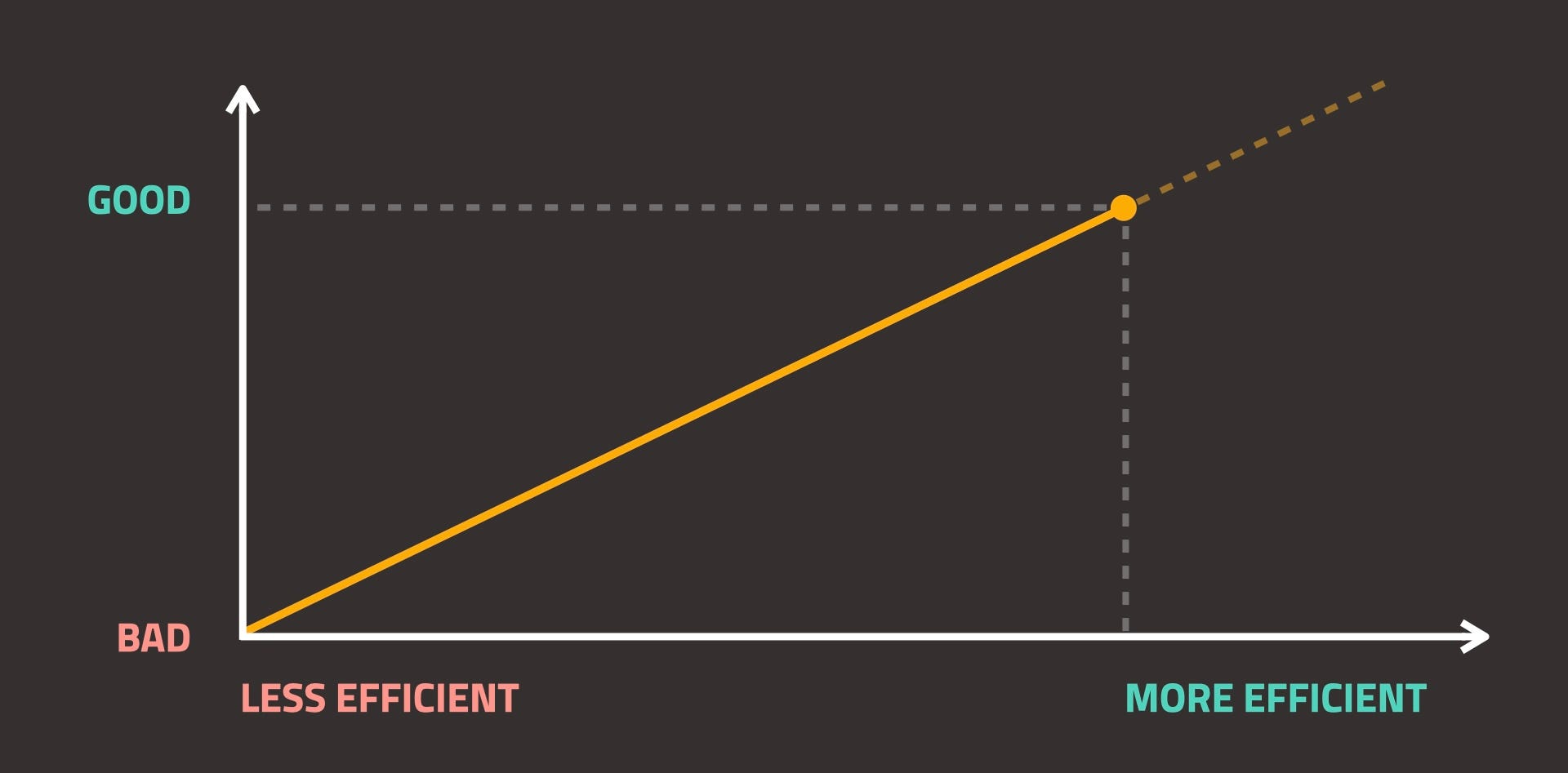
In this article, I want to step away from this one-dimensional view on efficiency that blindly considers any optimisation as inherently good. Instead, I also look at the destructive side of optimisation when it is based on metrics that ignore customer experience. The ever-increasing automation of everything in today’s world is making this topic particularly relevant, I believe.
Two dimensions of efficiency
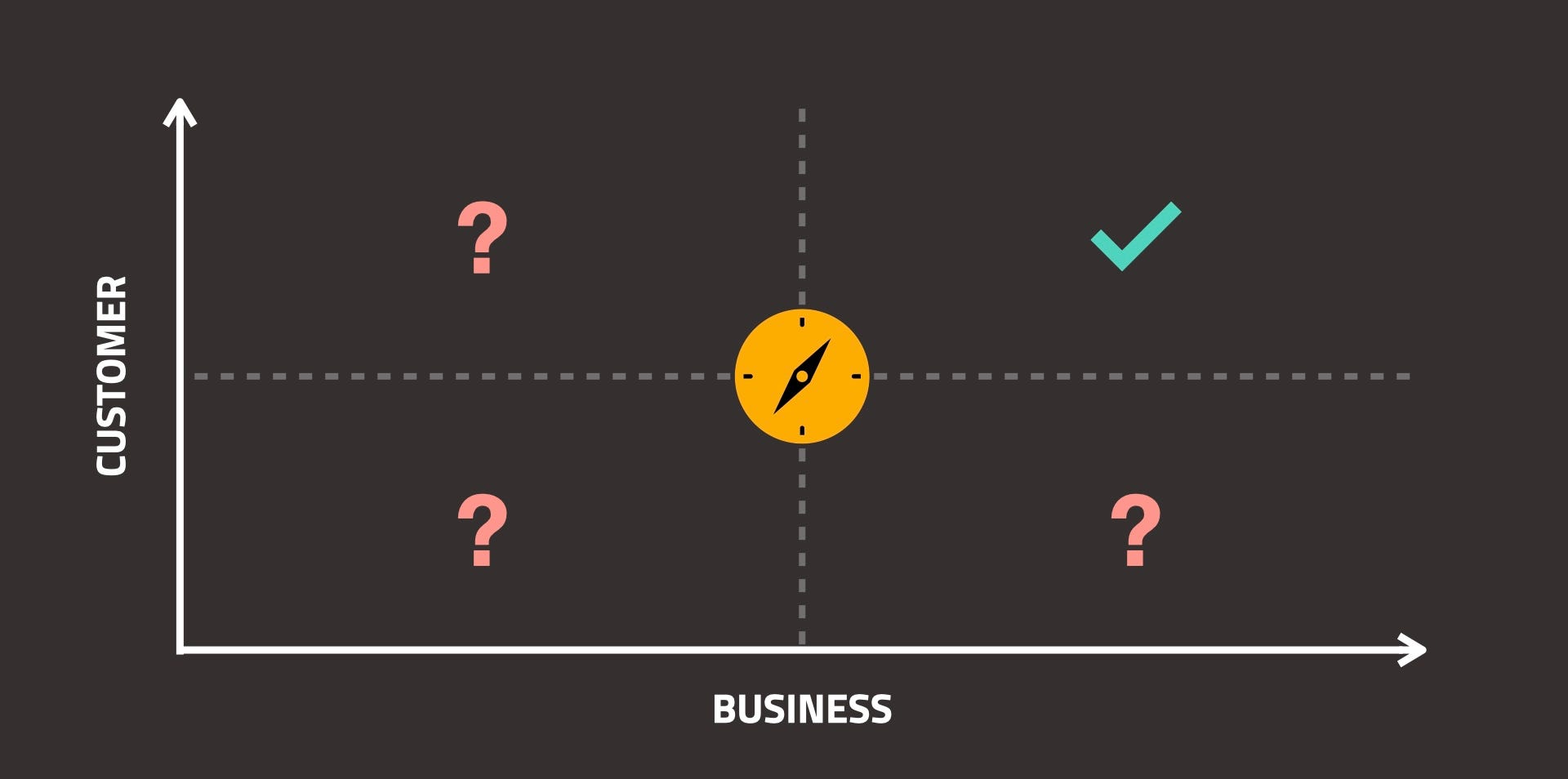
When a business is making anything more efficient, we have to look at it from two perspectives:
business profitability – how much profit will it bring to the business;
user experience – how much will the customers benefit from it.
Since every optimisation is initiated by the business itself, it usually implies more profits already. It usually comes from less spending, for example because of faster production times, fewer employees, smaller energy bills, lower maintenance costs, etc.
Yet none of these automatically benefit the customer. Quite often it’s the contrary, and it’s up to the company to decide whether to lean more towards benefiting the business or towards benefiting the customer.
A good example demonstrating this division can be seen in the movie The Founder (2016), which tells the early history of McDonald’s — the famously large chain of fast-food restaurants. There are two distinct moments in the movie showing efficiency as a good thing and a bad thing for the customer, and they are worth thinking about.
Good McDonald: the kitchen
The whole point of the McDonald’s initial success was the extreme optimisation of their processes that dramatically reduced the waiting time for the customer.
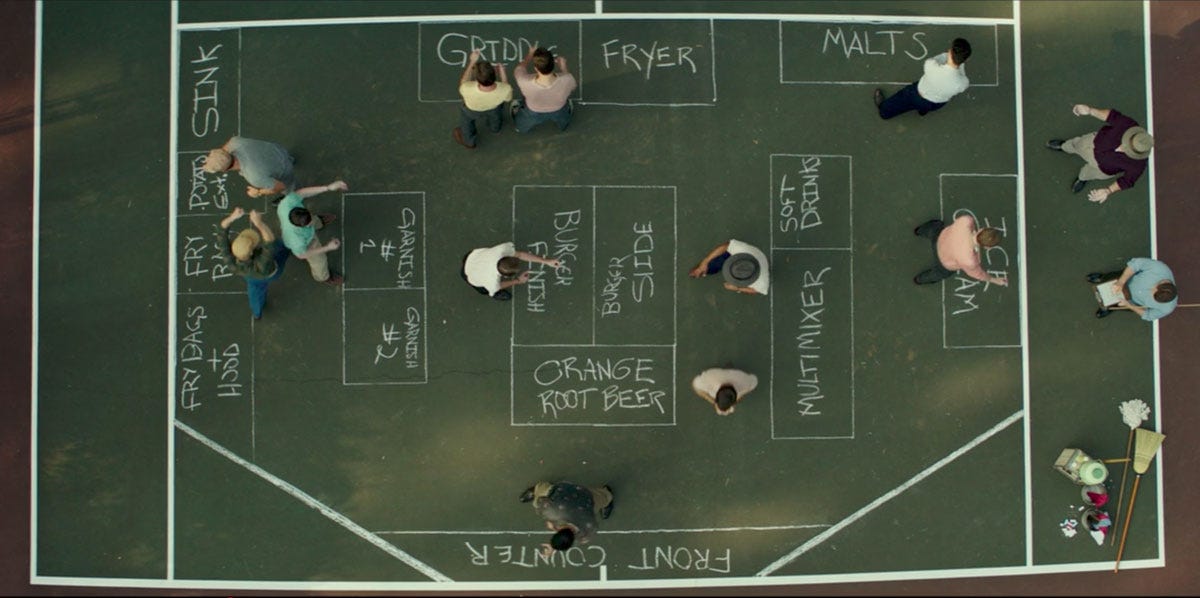
Essentially, their strategy was built on two pillars:
only serve food that can be eaten by hands, to eliminate plates and cutlery that require a lot of time and effort to handle;
optimise kitchen layout for the fastest possible preparation time of every meal, to work like a non-stop assembly line.
With the two things combined, you could get a ready meal in under 1 minute, while in a normal restaurant you’d have to wait for 20 minutes at least. That’s a massive difference that gave them a competitive advantage.
From the customer’s perspective, there is a clear value proposition — very fast serving time, which is why it’s called fast-food. And that is a valid reason for accepting certain compromises, such as limited choice on the menu or eating your food from a paper bag instead of using a knife and a fork. You lose something nice to have, but you gain something that is more important to you, in this case – time.
Bad McDonald: the milkshake
It’s not the same with the second episode, which is about the milkshake. As the story goes, when the chain grew bigger, milkshakes became a weak point on their menu. They were made of fresh milk and ice cream, which had to be stored in the fridge. This meant that every newly-opened restaurant needed to buy one, have enough space for it in the kitchen, and if the ingredients went bad, they had to be thrown away. So, to make it more efficient, they switched to a special dry-powder solution that could be mixed with water, creating a milkshake that looked and tasted pretty much like the one made from fresh ingredients.


This change clearly simplified logistics for the company, reducing its operational costs, but to the customer it had no benefit. On the contrary, the product was now less natural and contained more artificial additives to reproduce the taste and feel of the original milkshake. So we can say that this optimisation sacrificed user experience for the sake of business profitability, placing it on the negative side of our business-vs-customer diagram.
This decision was shown in the film as the one causing great tension between the original founders of the first restaurant, who were focused on customer experience, and the later business-oriented co-founder, who focused on growth.
Obviously, there is no magic here. What you focus on is what you get, and there is nothing inherently wrong with growth itself. But when it comes at a cost of user experience, efficiency alone stops being a virtue. As a business owner, one has to recognise the spectrum of available choices and honestly place every decision on that spectrum. And that’s what ultimately defines the values and the brand of a company.
It’s a ROC curve
There is a concept we use a lot in statistical analysis of data from LHC experiments — the ROC curve1 (Receiver Operating Characteristic). It reflects the inevitable compromise between the purity and the size of a dataset after applying a certain selection criterion. When you push for the cleanest possible data sample, it becomes very small. If you relax the criterion to have a bigger sample, it gets contaminated with unwanted data, becoming less pure. So we have to decide how much contamination we can accept for the sake of getting a bigger sample.
💡 Because it’s a curve, and not a straight line, we usually don’t pick the minimum or the maximum, but instead pick a point somewhere in between, to get the best value for money, so to speak.
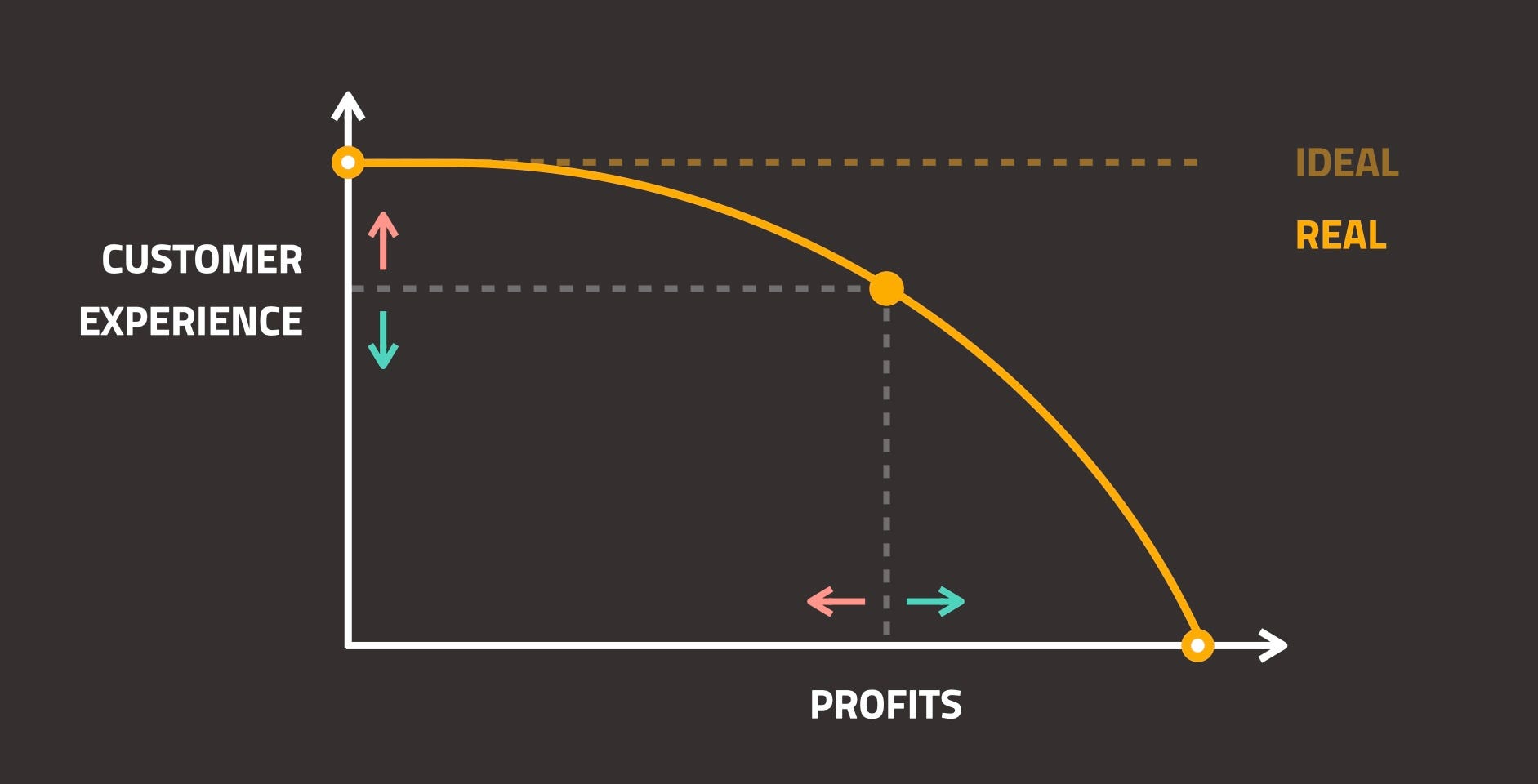
The same can be seen in business — simple optimisations don’t just improve profits, as they would in an ideal world, but they also affect customer experience. So in reality, one has to choose a compromise between the two, and there is no golden rule. It’s always a matter of choice and priorities in every specific case.
The mistake businesses often make is treating decisions as a binary choice: either maximum profits or maximum customer experience. As a result, they reject or don’t even recognise more nuanced or complex options that sit somewhere in the middle, which would lead to a more balanced outcome.
Good example: MISCUSI
Recently I’ve come across an example of such a balanced optimisation approach at the MISCUSI2 restaurant in Turin (Italy). They’ve been known for their pasta with outstanding quality and affordable prices. When I’ve heard about them 10 years ago, you’d have to queue outside for 15-30 minutes. During lunch time there would be a person adding your name to a long list on a sheet of paper, after which you would have to wait for a free table to appear, and only then your name would be called. They would bring you a printed menu and accept minor ingredient adjustments, because everything was freshly cooked on the spot.


A few weeks ago I was eating at MISCUSI again. They now have two spots in Turin, and they’ve grown to a total of 15 locations across Italy, London, and Geneva. Yet I haven’t felt like my user experience has degraded in any way. On the contrary, it actually improved, despite their growth into a small chain of restaurants now.
Below I want to mention 3 details I’ve noticed that demonstrate the non-obvious choices they must have made along the way. I think these are good examples to follow.
Freshly-made pasta
They are still making their fresh pasta in-house, which is now more emphasised than before. Large bags of flour stacked by the windows and a pasta-making machine behind a glass wall periodically operated by a dedicated person — this all reinforces the expectation that food here is going to be fresh.


Given that they are still getting the same kind of long queues at lunchtime as 10 years ago, they could have optimised their process further: produce it centrally in large volumes, dry it for long-term storage and distribute the ready-made pasta to their restaurants. That would simplify logistics and would free up space for another 1-2 tables at each location, bringing extra profit.
Yet they’ve kept it less efficient, only optimising the pasta-making process in each restaurant, to preserve the original level of quality. This says something about their values and priorities.
Menu flexibility
In contrast to the paper menus from 10 years ago, now you order from your phone by scanning a QR code at the table. It brings you to an interactive website where you can manage your order, all the way to choosing individual ingredients for your pasta from scratch.


And while the app covers probably more than 90% of all possible use cases, they did not discourage in any way the direct interaction with a waiter. In fact, all their staff members have a small earpiece with a radio that lets them talk to each other at any moment. A waiter can check if there is an empty table on the other end of the restaurant or check with the kitchen if the sauce contains a particular ingredient, all within seconds, while standing by your table.
Again, the interactive menu has not replaced the waiter and has not forced customers to stay within the predefined choices in the menu. Instead, it reduced the load on the waiter by letting those 90% of customers do everything through the website, which allowed the waiter to be even more helpful to the remaining 10% who need extra care.
Table booking
Today you can book a table in any of their restaurants through the same website, which is fairly convenient and simple. Yet if you come during rush hour at lunchtime, you still can leave your name, and they will put you on the waiting list with a rough estimate of the waiting time, exactly like they did 10 years ago.
They use their electronic system now instead of pen and paper, but for the customer, the old way of interaction remained unchanged. To be fully efficient, they could simply point everyone to the QR code to book a table online and not bother with writing people’s names. Yet they chose a compromise — reduce the load by adding a more efficient option, not eliminate it completely by enforcing just one option.
Notable bad examples
Here are some examples I noticed where businesses tend to blindly push efficiency to the maximum, sacrificing user experience.
Customer-support AI agents
To cut costs, many companies have introduced AI chatbots as the customer-facing layer of technical support, and made it practically impossible to speak to a human now. While a chatbot can resolve the issue for the majority of support cases faster than a human, it can be completely wrong and useless in more nuanced cases that require human understanding and reasoning. Their experience became worse without fast access to a human, being redirected to much slower email support. A slightly less efficient way would be to keep a fraction humans online, chiming in when the customer is not satisfied with the chatbot’s answer.Self-checkout in grocery stores
A self-checkout terminal is financially more efficient than a human cashier as it doesn’t need salary, while executing its main functions equally well. Except for the cases when it doesn’t — unregistered or damaged barcodes, alcohol that needs age verification, scales malfunction, etc. All these cases require an employee to come and resolve the issue, which sometimes can take a few minutes. These cases are relatively rare, but when they happen, the experience becomes much worse than with a human cashier. Instead of 5 terminals replacing 5 humans, they could replace just 4 humans, leaving one to always be around the terminals.Online-only orders
Some places, from Domino’s Pizza franchise for example, do not allow walk-in orders, forcing people to order online through their app. While it does make logistics simpler for the owner, it forces customers to go through an unnecessarily complicated process to simply order a pizza. As a less efficient alternative, they could simply add an extra fee for in-person orders to position their app as a cheaper option. The customers who want to quickly pick a pizza while driving by would surely get a much better user experience.Touch controls in cars
After Tesla introduced big touch-screens to control everything in a car, other manufacturers quickly replaced all physical knobs and switches by touch controls on one small screen. Almost every driver would have preferred tactile physical controls that have instant feedback and can be used reliably without even looking at the screen. But it is easier and cheaper for car manufacturers to produce, so they’ve pushed everything they could to the touch screen. A less efficient way would be to keep physical controls for the most critical and often-used functions, such as volume/mute switch, AC on/off, glovebox latch, wiper controls, etc.
In fact, the reason it worked for Tesla is because it was marketed as a car for tech geeks, who would naturally be excited about touch controls because of their novelty, so it was a reasonable compromise, like it was for McDonald’s removing plates and cutlery. But other car brands don’t have the same customer base, so when they adopt this kind of optimisation, it compromises customer satisfaction way more.
Finally, returning to McDonald’s, apparently this is how children's corners are starting to look in some of their locations3 in the US. Again, more efficient for the company, and more junk for the customers compared to the usual rooms with physical toys.


Epilogue
With all these examples, my message is simple – optimisation is almost never one-dimensional. When you optimise one thing, something else inevitably gets worse. It’s not up to me to decide which one you should care about more. All I ask is to be aware of this compromise and consciously make honest decisions that align with your brand and values.
After all, fast food and junk food are not related semantically. They’ve become synonymous because of systematic decisions that fast-food chains have made, over and over again.
Returning to the case of MISCUSI, their food is less fast than McDonald’s, there is no doubt about that. But it’s also certainly not junk. And I wish more companies chose to trade a bit of efficiency and business profits for making their customers feel less junk.
MISCUSI chain of restaurants, official website
Photos of a digital-only PlayCorner in McDonald’s, artifaxing and Laurence Fishman