


So far I’ve never had more money than I can possibly spend, which means that it has always been a limited resource for me, as it is for the vast majority of people. And as with any limited resource, its spending must be limited and prioritised wisely, to keep it sustainable.
Ever since I’d become financially independent, any purchase I’ve made has gone through an internal justification process that boils down to one question – “Is it worth the price?”.
Here I want to share my pragmatic approach to this question, which doesn’t seem to be as widespread as I thought. I believe it would let you spend your money more wisely and be less affected by marketing manipulations.
💎 The thing to buy
First of all, let me clarify the exact type of spending I’m talking about, since it doesn’t necessarily apply equally well to every situation. I’m talking specifically about the cases where you want to buy something – usually an object – that exists in several variations at different price points. Therefore, you need to decide whether to buy the cheaper version or the expensive one.
This object can be anything – from a winter jacket or a pillow to a cooking pan or a pair of headphones. As long as you need just a thing – like a smartphone, and not the thing – like the iPhone 17 Pro 256GB, you’ve got multiple options to choose from.
If you need something very specific – there is not much to think about. You either have the money or you don’t 💁🏻
💰 The budget
Before even starting to evaluate any specific spending, you need to know your budget – how much can you possibly spend? These are not the money you currently have in your bank account, but the money you can spend without affecting the rest of your life. This means that you’ve subtracted the money you have to spend on all your basic needs, like rent, food, commuting, savings, and any other purchases you have to make. The rest – you can spend on your purchase and keep living your life as usual.
When it’s a big purchase that is planned way in advance, like buying a house, a car or something so expensive that takes several months of savings, you’d need to do some maths to calculate the expected amount of money you’ll have at the moment of the purchase.
Either way, you need to have a cut-off number – the maximum amount you can possibly spend on the purchase, which often reduces the number of options you can even consider. Usually the fewer are the options, the easier it is to choose.
☑️ Algorithm of choice
Let’s say your budget is €2000 and you need to buy a new smartphone. To simplify the problem, let’s say you’re already in the Apple ecosystem, so it has to be an iPhone – no other brand. But which one exactly?
With the €2K budget, today in Italy, you technically can buy the most expensive version (iPhone 17 Pro Max 2TB for €1999). But if you buy a cheaper one (iPhone 17 256GB for €799), you’ll have more money left to spend on something else in the future.
1️⃣ Spending → Saving
So the 1st step of my pragmatic approach is to reformulate the question in terms of saving rather than spending. Instead of asking yourself:
❌ “Should I buy a €1999 phone or a €799 phone?”
ask yourself a different question:
✅ “What should I spend the extra €12001 on? A nicer phone right now or something else in the future?”
Now, you can’t be sure what exactly you would spend these saved money on, yet it’s safe to assume that you’ll spend them on something that contributes to your everyday life. And the bigger chunk of life you take, the more possibilities it will contain to spend these saved money.
These can be the freedom to go to a concert, or travel to another country, or buy something you might enjoy. Either way, not having the money in the future will limit your possibilities and degrade your user experience with respect to the scenario where you do have the extra money. So unless you’re into “Live Fast Die Young” philosophy, saving money for later seems like a better option.
2️⃣ Money → Time
The 2nd step is to translate the problem from the dimension of money to the dimension of time. Instead of asking yourself:
❌ “What should I spend the extra €1200 on?”
ask:
✅ “How long would these €1200 serve me if I spend them now?”
Assuming a stable source of income, the longer chunk of life you take, the larger budget you will accumulate, making these €1200 seem less and less significant over time. Therefore, in addition to the usual parameters like the price, list of features, cool-factor, etc., you might also consider how long will this purchase serve you.
This is essentially what accountants call amortization2.
3️⃣ Resale or not resale
The last point to consider is what happens to your purchase at the end of service – will you throw it away, pass to someone else, or sell it? If you plan to sell, then estimate how much money you’ll get back and include that in your spending/saving calculation.
Furthermore, the plan to resell can affect your decisions in steps 1 and 2, since different models can depreciate differently over time, or even change the way you’d use them in the first place.
Returning to the iPhone example, you might choose a model based on its colour and finish. But if you put a protective case around it, to keep it like new and maximise its resale value, then you won’t actually see and feel that finish anyway, making it a useless criterion to decide on.
⏱️ Example: my watch
About 10 years ago I’ve decided that I want to wear a wrist-watch, which should have a minimalist Bauhaus-style design. After some research I’ve found my favorite model – mechanical Junghans Max Bill3, which had the right aesthetics accompanied with a satisfying ticking sound of its analogue mechanism. But at that time it was out of my budget.

So I ended up buying a much cheaper alternative – quartz Brathwait Classic Slim, which had a somewhat similar, but less sophisticated look, and was powered by a simple mechanism with a battery. It certainly didn’t look or feel as premium as the Junghans model, but it did the job for the budget I had.
About 8 years later I’ve got the budget for the Junghans watch, which I’ve bought without hesitation. And at no point during those 8 years had I considered getting an Apple Watch, which would provide a ton of extra features at a much lower price. To a large extent my reasoning was driven by the expected time of service.
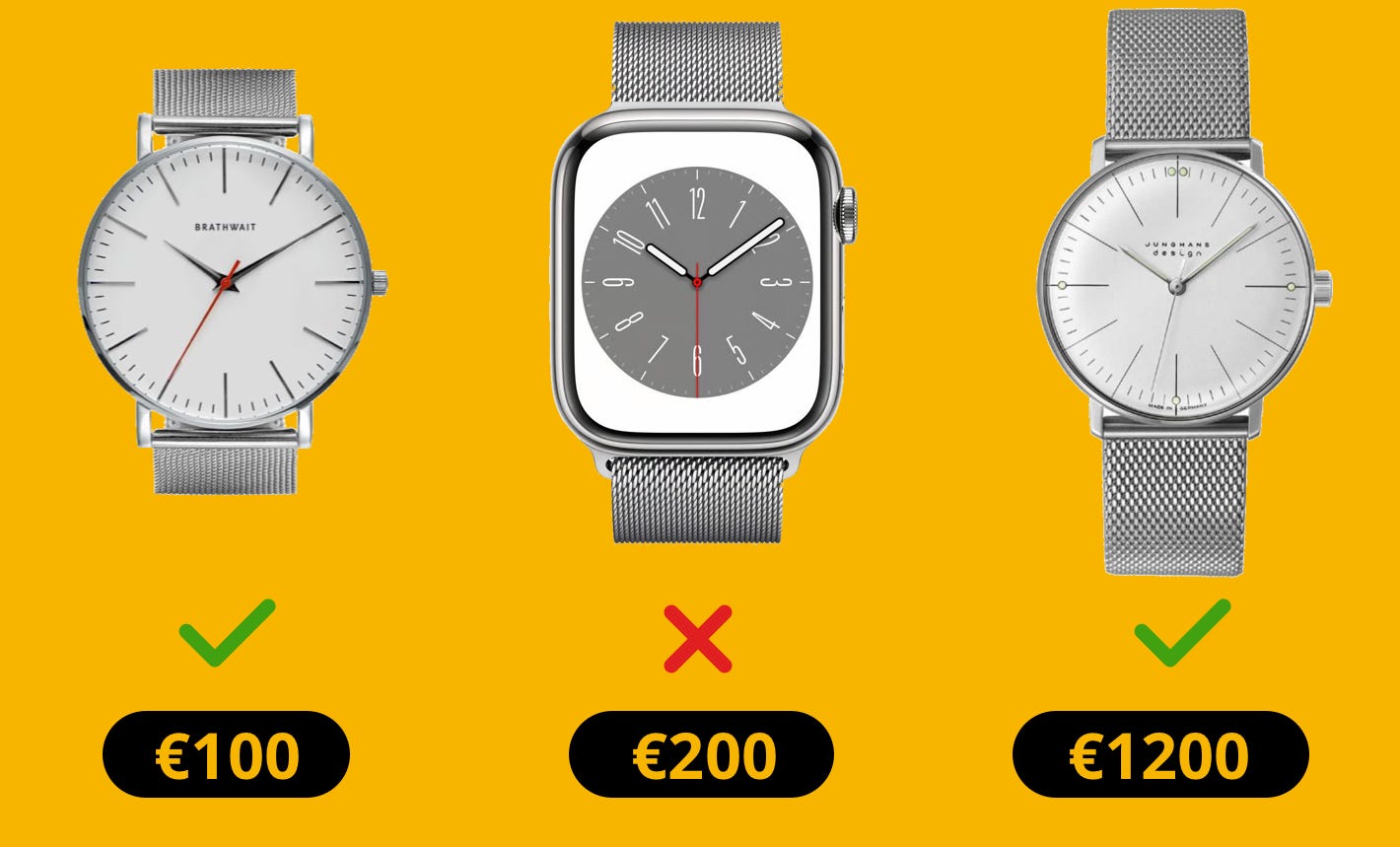
Both left and right watches have a time of service that may easily exceed my own lifetime, limited only by their physical breakdown. The quartz watch is in a little weaker position, as it needs a new battery every year. Probably at some point such watches will disappear from the market, together with batteries for them, but I don’t expect this to happen any time soon. Having a stainless steel case and a scratch-resistant sapphire dome, it barely changed its appearance, so I would say that it served me very well for those 8 years.
The watch on the right doesn’t even need a battery, so having the same steel+sapphire construction and even more timeless design, it can last for way longer, serving not just me but also someone after me. This can’t be said about the Apple Watch, as it is designed to become obsolete after 5-10 years. Its hardware will become unsupported by the evolving Apple ecosystem and its non-replaceable battery will lose capacity, eventually making it unusable as a watch.
It’s worth noting that I had an option to buy a cheaper version of the Junghans watch, featuring a dome made of plexiglass instead of sapphire. That would greatly increase the chance of scratching or breaking it, effectively reducing its service time. So going for the sapphire option was an obvious choice that better justified the price of the whole watch.
Obviously, it would be a very different list of criteria projected on a shorter timeline if I were choosing a smart-watch instead of just a watch. Considering how rapidly these technologies are developing, I would be looking at the timeframe of just a few years, where price difference of even €100 would play a much bigger role.
♻️ Anti-consumerism
Looking at things through the lens of their service life forces you to be mindful about sustainability of your purchase, in line with the anti-consumerist mindset. It’s easy to fall into the countless marketing traps that convince us to buy something based on a cheaper price or a limited-time discount, exploiting our urge to save money. Quite often that amount you’d save becomes insignificant once you look at it from the time-of-service perspective.
In most cases the time of service is defined not by the product’s nature but by your intention. Take a chair for example – it’s a pretty simple functional object that can easily last for 100 years, if made well. Yet it’s your own decision whether to buy it for a lifetime or for a blink.
In IKEA4 you can get a cheap chair that would only last a couple of years, because of its poor quality. It’s designed for short service life, which is marketed as an opportunity for you to change your interior many times throughout your life. So choosing a more expensive alternative of higher and more enjoyable quality is only justified if you intentionally decide to keep it forever – choosing quality over quantity.
You might not want to do that if you’re buying it for a rented apartment in a city that you’re planning to leave in a year or two. But if you’re in a stable long-term location then why being a scrooge? 🤔
🧠 Premium mindset
Something I’ve noticed is that many people put themselves into a certain category of wealth and stick to it at all times, no matter what they’re buying. To put it simply, upper-class people only buy expensive things and working-class people only buy the cheapest things. And it doesn’t matter what the thing is – a car 🚙, a winter coat 🧥 or a kitchen knife 🔪 – in each product category they will only look at the price point marketed for their class.
I would argue that if you start considering the time of service, you can unlock premium quality in certain product categories with negligible effect on your budget. This would improve your user experience and make life more enjoyable.
Returning to the product categories I’ve mentioned above, let’s have some rough estimate of their cost and time of service:
🚙 – a car would cost at the order of €10000 and serve you for 5-20 years;
🧥 – a coat would cost at the order of €100 and also serve you for 5-20 years;
🔪 – a knife would cost at the order of €10 and easily serve you for 10-50 years.
I’ve only mentioned the order of magnitude for the cost to demonstrate the amount of money we’re playing with when choosing between a cheap and high-end version of a certain product. If you spend extra €200 on a car, you’ll hardly notice any difference compared to the base version, but for a knife – it will be something out of this world compared to a cheap €10 knife, and it will last for much longer than a car.
🔪 Knife example
This is exactly what I thought when I visited Japan 🇯🇵 – a country known for the highest-quality professional knives. I’ve dedicated a budget that I could possibly spend at that time and bought the best knife I could find for the money, with my name engraved on it by a Japanese guy working at the store.
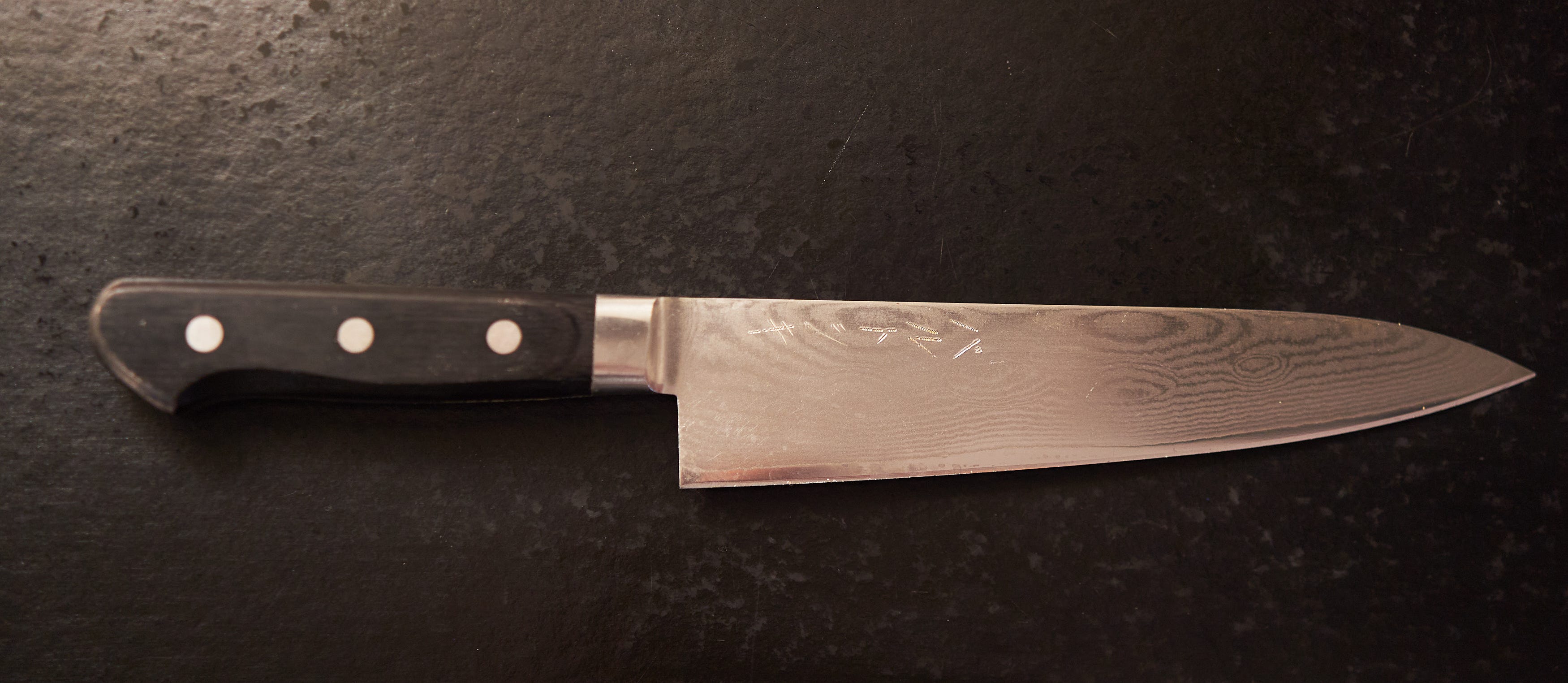
Now, every time I’m cooking at home – I’m enjoying the look of it, how smoothly it cuts through vegetables, how nicely the handle feels in the hand, even the sound it makes when wiping it with a towel. A cheap knife doesn’t simply break sooner, or loses sharpness faster. Some of these aspects you will never experience in a cheap knife, even when it’s brand new. And if you never reach the upper class, you’ll never get that bit of daily life experience, which was totally within your reach all this time.
It has been 4 years now that I’m enjoying my Japanese knife, but my target is 40 years at the very least. For that purpose I’ve also brought a Japanese sharpening stone, which could probably last for a 1000 years. Maybe I should carve my name on it as well, for the future archeologists… 🤔
A similar logics would apply to a coat – you could spend extra €200 to get a really high-end piece made of high-quality materials that would last for decades and age more gracefully. The only catch is – your body-shape or your aesthetic tastes might change over such a long time, putting a limit on the maximum time-of-service you can practically target.
⭐️ Justified premiums
Putting in practice this time-of-service approach, here are a few examples of products that are totally worth extra price.
🍴 cutlery (spoons, forks, knives) – you hold them in your hands, put them in your mouth, they’re are practically indestructible;
🖋️ stationary (pen, ruler, stapler) – you feel it with your hand, can last for ages;
🪮 comb or hair brush – good designs last for ages;
🔈 passive loudspeakers – you can switch amplifiers over time, but a good-quality speaker will preserve sound quality for decades;
🪑 furniture (if staying long-term) – can easily serve multiple generations and you get to look at it and touch it every day;
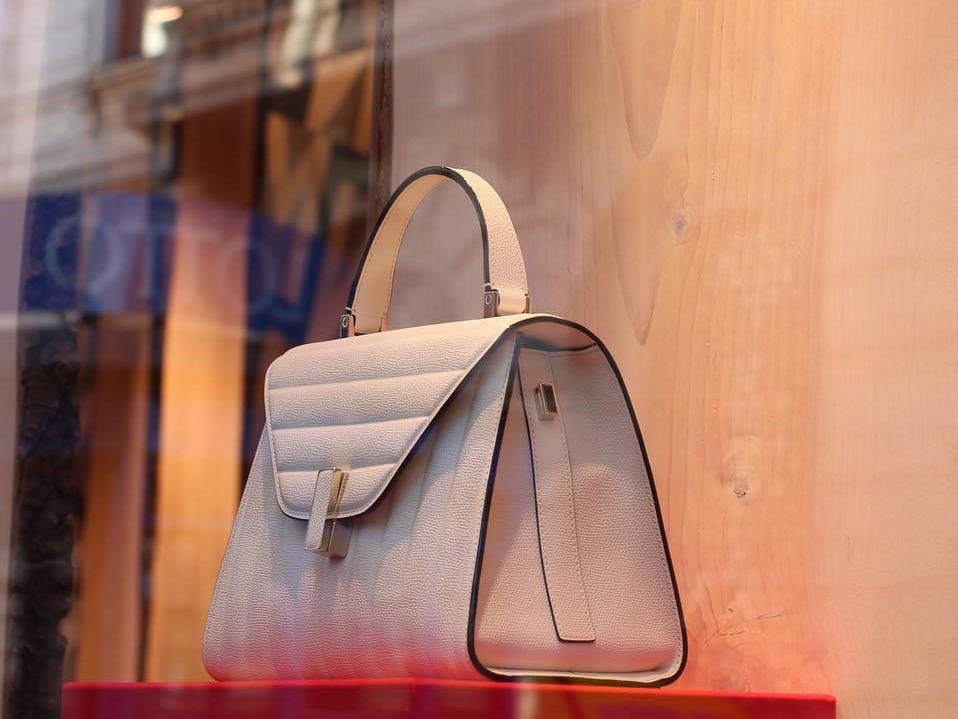
👜 bag or purse – cheap ones break after few months; quality ones last for years and look better;
👟 shoes – when made of high-quality materials they can easily last for 10+ years and age quite well;
💍 jewelry – we have samples preserved from ancient civilizations;
🫖 kettle or mokka pot – very simple construction and working principle that is hard to break, but can be a piece of interior;
🛠️ mechanical instruments (screwdriver, hammer, wrench) – you get to feel them in your hands and they’re meant to last.
Many more can be added, depending on your lifestyle and priorities, but I think you get the point.
🎬 Epilogue
As mentioned in my earlier article on UX, I care a lot about getting the most enjoyable user experience out of my life under any given circumstances. This is why I look for ways to use high-quality products when it matters and the situation allows.
In all my examples I’ve only considered features of the products themselves, which is not always enough. All these time-of-service projections might be overestimated when taking into account external factors, like living in an area with high robbery rate, where your beautiful watch or coat, meant to serve you for 30 years, is likely to be stolen in the next 2 years. I wouldn’t invest in buying high-end furniture for my home if I lived in a war-zone city that is bombed every day. I wouldn’t buy expensive jewelry for a scatterbrained person who is likely to lose them in a year or two.
Another important aspect – high price doesn’t always mean high quality that will extend the time of service. This is particularly relevant for clothes in the modern age of fast fashion. Making sure that you’re overpaying for quality and not for the logo might require some research.
I believe it’s totally worth the effort, as it will make your personal user experience more enjoyable and improve sustainability of our society as a whole.
€1200 = €1999 - €799 (money saved when buying the cheaper version)
Junghans Max Bill, Web catalogue