


It’s December right now, which is the cold season here in Turin (Italy). It forces us to change some of our daily routines, the most immediate of which is – wearing warmer clothes. I’ve already discussed in an earlier article what and how to wear to stay warm. If you follow those recommendations, you should be able to wash your clothes less often than in summer, thanks to less sweating and better isolation from sources of dirt.
The problem
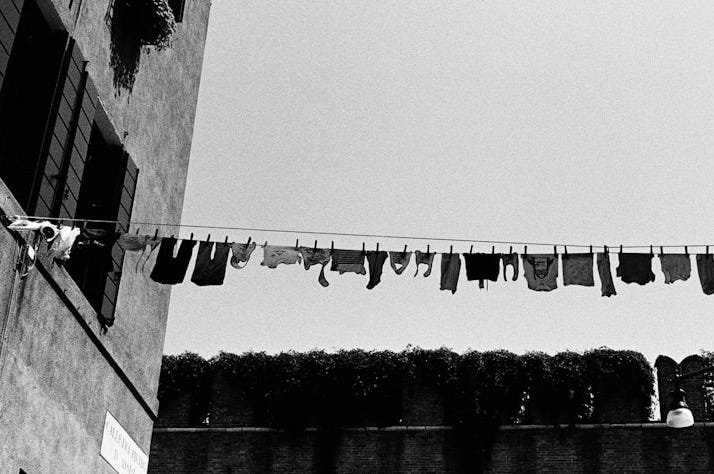
There is one aspect though that complicates life – individual pieces of winter clothes are generally thicker and heavier. They absorb more water during washing, which makes them harder to dry. The lower temperature, both indoors and outdoors, doesn’t help either.
As I’ve already mentioned in my post about the fridge, humidity is a problem, as it is the prerequisite for bacteria to multiply. This increases the risk of infections in case those are some dangerous bacteria or fungi. And almost certainly there will be some stinky bacteria among them, which primarily come from your skin and body oils. When they multiply they can reach concentrations at which you can feel their smell quite strongly, which is not great either.
The objective
Sticking to my target of the best user experience, I want my clothes to be dry while satisfying the following conditions:
have no bad smell;
use little energy (in kWh);
do little damage to the fabric;
take as little time as possible.
I’ve ordered them from the highest to the lowest priority, as would be during my normal washing routine. You can tell that I’m quite sensitive and intolerant to bad smells. If I can save money or preserve quality but the clothes smell bad as a result – I’m not interested, because I won’t enjoy wearing a shirt that stinks.
💡 Obviously, if I’m in a rush and have a very specific shirt to wear the same evening, this list will look different. I might have to compromise on the energy efficiency or fabric longevity for the sake of saved time.
In the following I will go through all the relevant aspects of making clothes dry, such that you can come up with the optimal process for your own list of priorities, even if it’s completely different from mine.
Humidity
Considering that humidity ⨉ time = bad smell, it would be silly to keep your clothes wet for no reason, even if it consumes no energy and doesn’t damage them.
Therefore, first and foremost – take your clothes out of the washing machine right after the end of the cycle. If you know that you’ll go to sleep or leave for work before the cycle ends – better don’t start it. Do it when you’re sure that you’ll have the time to unload your washing machine right away. Your clothes might smell better with just a small time-management tweak.
You certainly can reduce the initial amount of bacteria to start with by using a sanitizer or increasing the water temperature. Hot water will kill more bacteria, but it consumes more energy and ruins the fabric faster. Instead, a sanitizer adds a minor extra cost, cupboard space and potentially a smell of its own. So if you definitely have to leave them wet for hours, a sanitizer is probably a better option to avoid bad smell.
The physics of dry clothes
Turning wet fabric into dry fabric means removing all the water from it. The biggest amount of water is removed by simply squeezing it out, which your washing machine hopefully does for you already. It’s usually done by a spinning mechanism that creates a centrifugal force pushing the water outwards through the fabric and out. The surface tension of the water makes it stick to the fibers of the fabric, counteracting that centrifugal force. Therefore, the higher spinning rate you set in the washing machine, the more water manages to overcome this surface tension and escape the fabric.
💡 Too high spinning speed will squeeze the clothes too much, potentially overstretching them. This is particularly critical if you have different types of fabrics mixed together, like denser and heavier fabrics pushing and stretching the softer ones stuck in the middle. For this reason washing machines usually limit the spinning speed to around 400 rpm (revolutions per minute) on the Delicate program.
Once the clothes are out of the washing machine, there are essentially 3 physical aspects that define the drying process: heat, humidity and flow. Let’s look deeper into each of them.
Heat
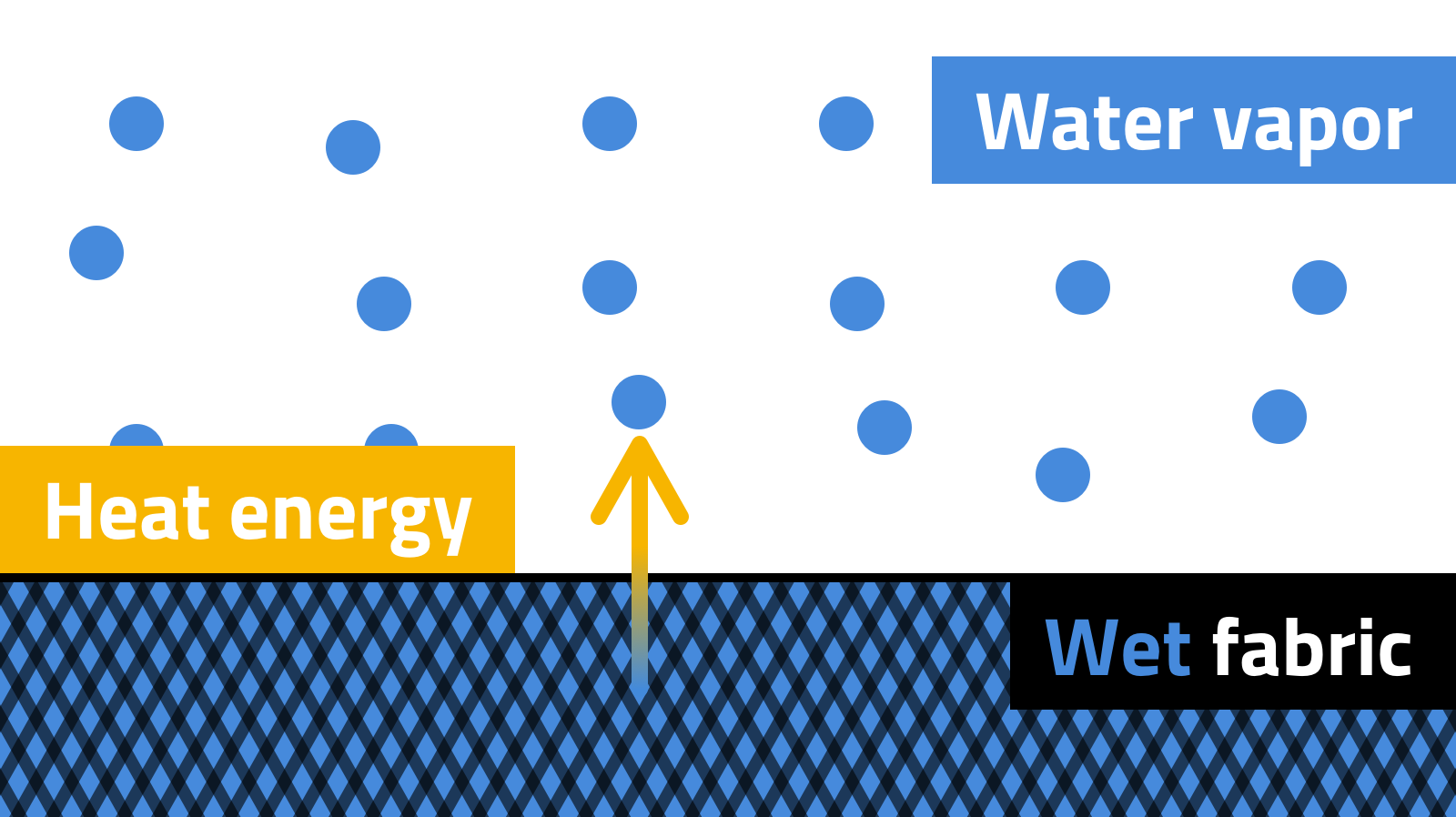
To leave the fabric, water must evaporate, which means transitioning from a liquid state into a gas. Since surface tension keeps the molecules of water together, they need extra energy to overcome that molecular bond and break free. This extra energy comes in the form of heat, which is taken away from the fabric, effectively making it colder. The higher is the temperature, the higher is the kinetic energy of the water molecules and, therefore, less extra energy is needed for them to break free.
💡 I personally use the same principle as a cheap way to make my floor feel fresh during hot Italian summers. When it dries after a quick wash with just a bit of water it feels noticeably cooler – quite pleasant for the feet. At a larger scale this principle is used in evaporative cooling towers of nuclear powerplants1, where the rising clouds of water vapor make it more visible.
Humidity
Evaporation brings water molecules into the surrounding air, which is the only relevant process when the air is perfectly dry. In practice though, there are water molecules in the air as well, which can condensate around the colder wet fabric and absorb back into it. So in reality evaporation and condensation are two competing processes, and humidity of the air defines the balance between them. The higher is the humidity the slower will the water actually evaporate from the fabric.
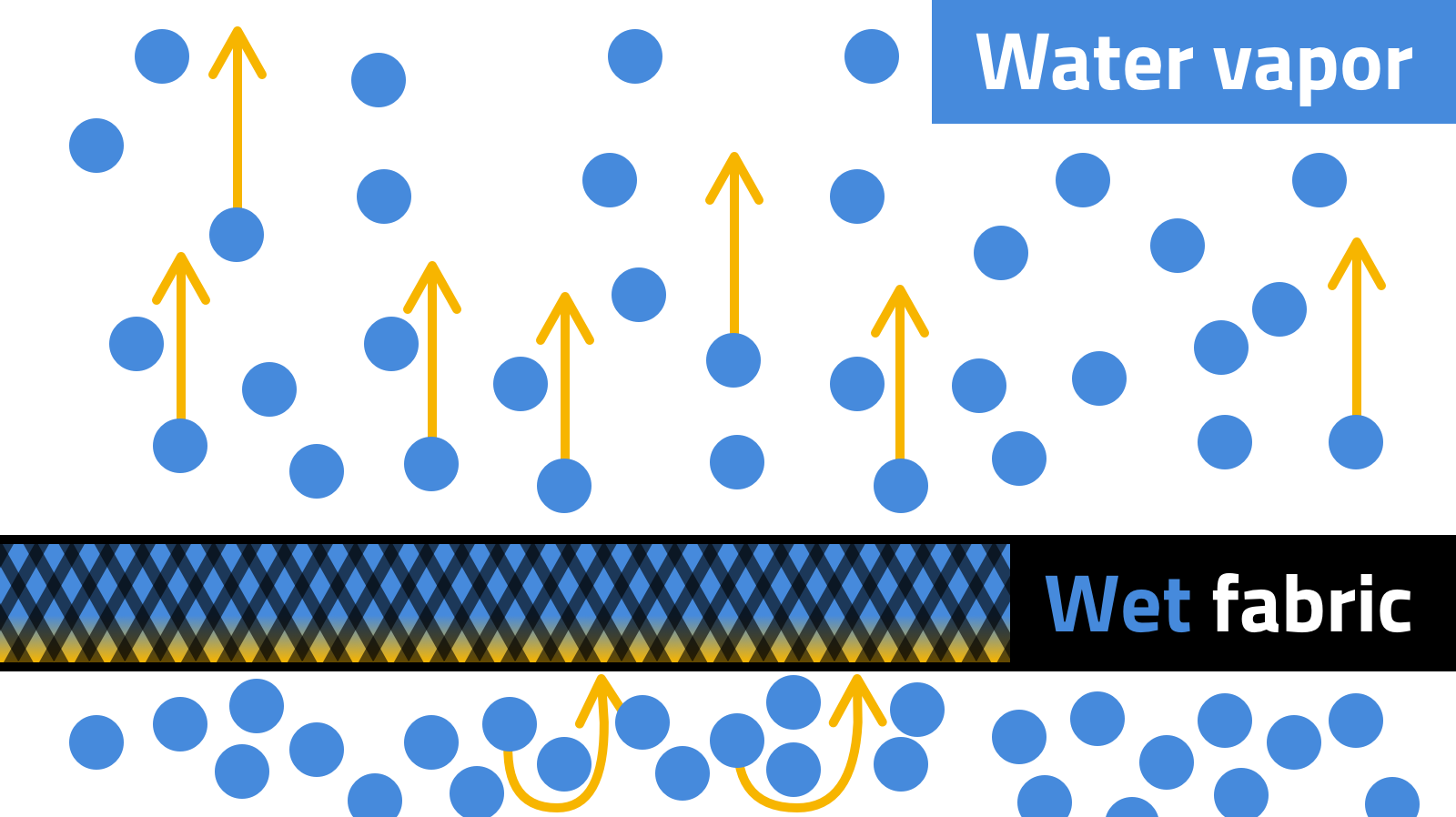
One important aspect of the humid air is that it’s lighter than dry air and normally rises up, which is what allows clouds to float so high up in the sky. For this reason the upper side of your clothes dries much faster than the bottom side. The air evaporating from the top side can rise freely into the air, whereas water evaporated from the bottom side naturally rises back into the fabric, keeping the humidity high.
💡 The lighter weight of humid air is the consequence of water having lower molecular mass (18 u) than nitrogen (28 u) or oxygen (32 u), which get replaced by water molecules (“u” stands for atomic mass units2).
Flow
As the water evaporates, the air immediately around the fabric becomes more humid. Even though it rises up as it is lighter than dry air, it happens very slowly, effectively creating a higher-humidity layer around the fabric. This build-up of humid air slows down the evaporation process, taking the fabric longer to dry.
If you create a slight flow of air, it pushes that humid layer away, reducing the effective humidity around the fabric. Furthermore, this flow reduces the air pressure, which also helps evaporation. This is why clothes usually dry faster outdoors, because even a slight breeze blowing through the fabric speeds up evaporation quite a lot.
How to dry fast
When you combine these three aspects together, you get the formula for the fastest clothes-drying method – the tumble-dryer. It continuously blows hot dry air through all the parts of your clothes, ensuring that the water completely evaporates from them as quickly as possible. It’s a perfect solution if you only care about the time, ignoring the other objectives from the beginning of this article like energy consumption and fabric preservation. A tumble dryer consumes extra energy to heat the air and wears down the fabrics faster through all the extra friction it creates. Finally, it occupies extra space that might be a dealbreaker too.
The next closest option in terms of speed is a hair dryer. If you direct its hot air on the fabric it can dry out in just a few minutes. It still consumes extra energy to heat the air, but it doesn’t add any friction to the fabric. Of course it is way less energy efficient than a tumble dryer, since a large portion of the hot air is wasted to heat up the whole room instead of being recirculated back into the fabric. Therefore, it is more of an emergency solution for a single piece of clothes that you urgently need to wear.
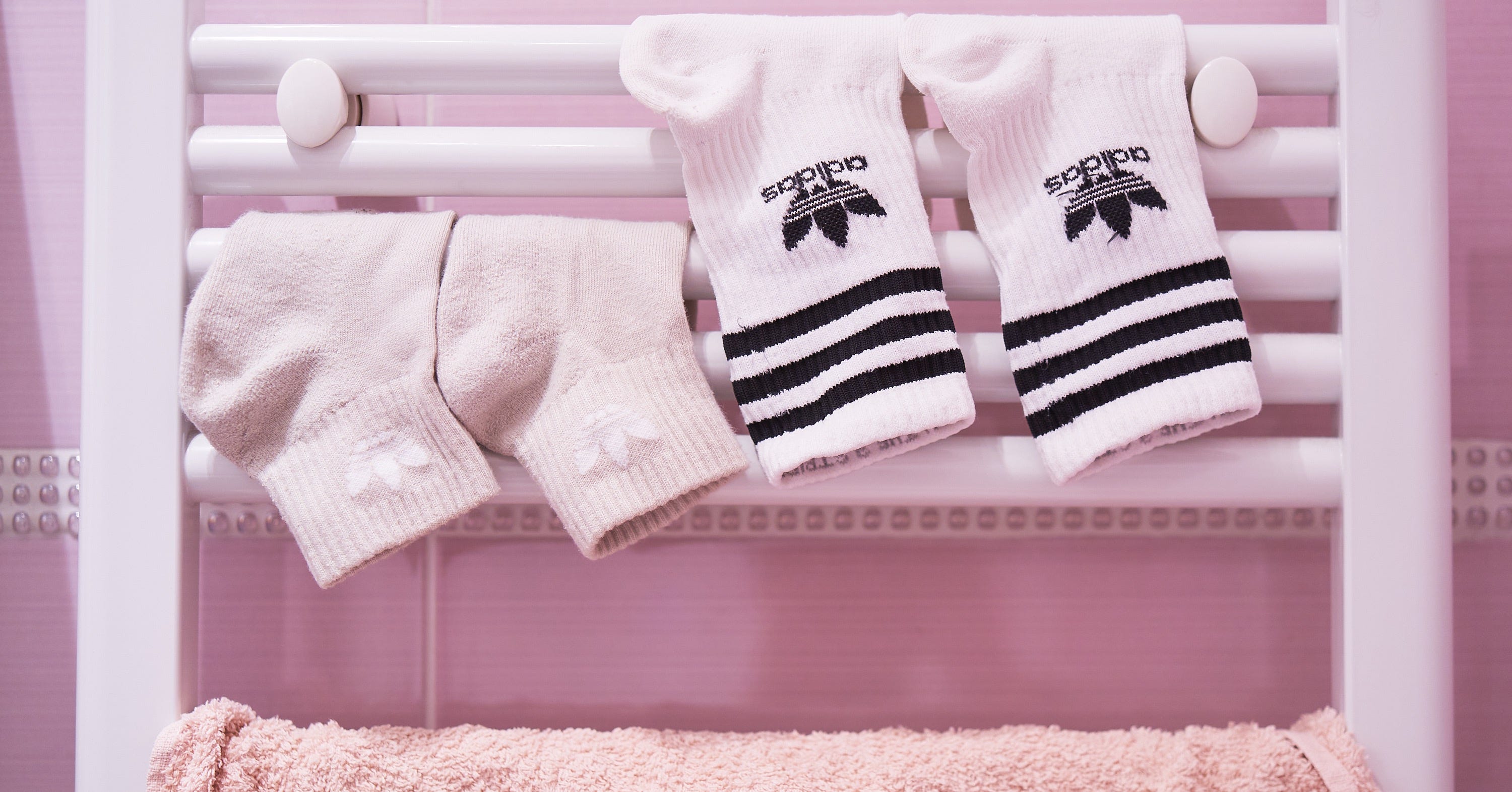
Finally, a heated towel-rail radiator in your bathroom, if you have one, is a good way to supply the extra heat to your clothes, speeding up the drying process. It’s certainly slower than the previous two methods, since it lacks the air flow, but still much faster than just leaving them on a normal drying rack.
Obviously, in all these cases you should pay attention to the instructions on the actual fabric, since this high temperature might be damaging to some of them. These might include nylon, silk, cotton with paint on it, etc.
How to dry fast and efficiently
Now let’s switch to drying clothes efficiently first and then fast. These are the rules I follow myself, which are simply the logical application of the basic physical principles that I’ve discussed earlier.
Spread your clothes
First of all, arrange your clothes such that there is the maximum fabric surface exposed to the dry air, through which the water can evaporate. This means spreading them well, such that there are as few layers of fabric sitting on top of each other as possible – no folding, no stacking.
If your rack has those thin wires, then hang each piece across a pair of wires, not just a single one. This creates more space for the dry air to pass between the inner sides of the fabric, drying them much faster than if they were touching each other.

If you don’t have enough space to hang all your clothes in this manner, consider getting a bigger or a second rack. Or get one that has thick tubes instead of wires – whatever allows to create that space for the air to pass.
Ventilate the room
As your clothes are drying, the evaporated water increases air humidity in the room, which then slows down the evaporation process itself. To prevent that, it’s wise to open your windows and let some fresh air in. Especially if you’ve been cooking before and your windows are misted-up, all that vapor in the air will slow evaporation down quite a lot. If you have a humidity meter in your room, that’s a good way to watch how it’s changing and to decide when to air the room.
💡 Maybe unless you grew up in Germany, because then you’re probably airing the whole house every single day regardless – lüften3 as it’s called.
Add some wind
The final step to massively accelerate the drying process is to create a flow of air through your drying rack. I personally use a small fan at the lowest speed, just to create a slight breeze, without adding any acoustic noise. I think that the optimal arrangement is having it on the floor, directed slightly upwards along the lines of the hanging clothes. This steadily pushes away the humid air trapped between the vertical layers of fabric, and replaces it with heavier dry air picked from the bottom.
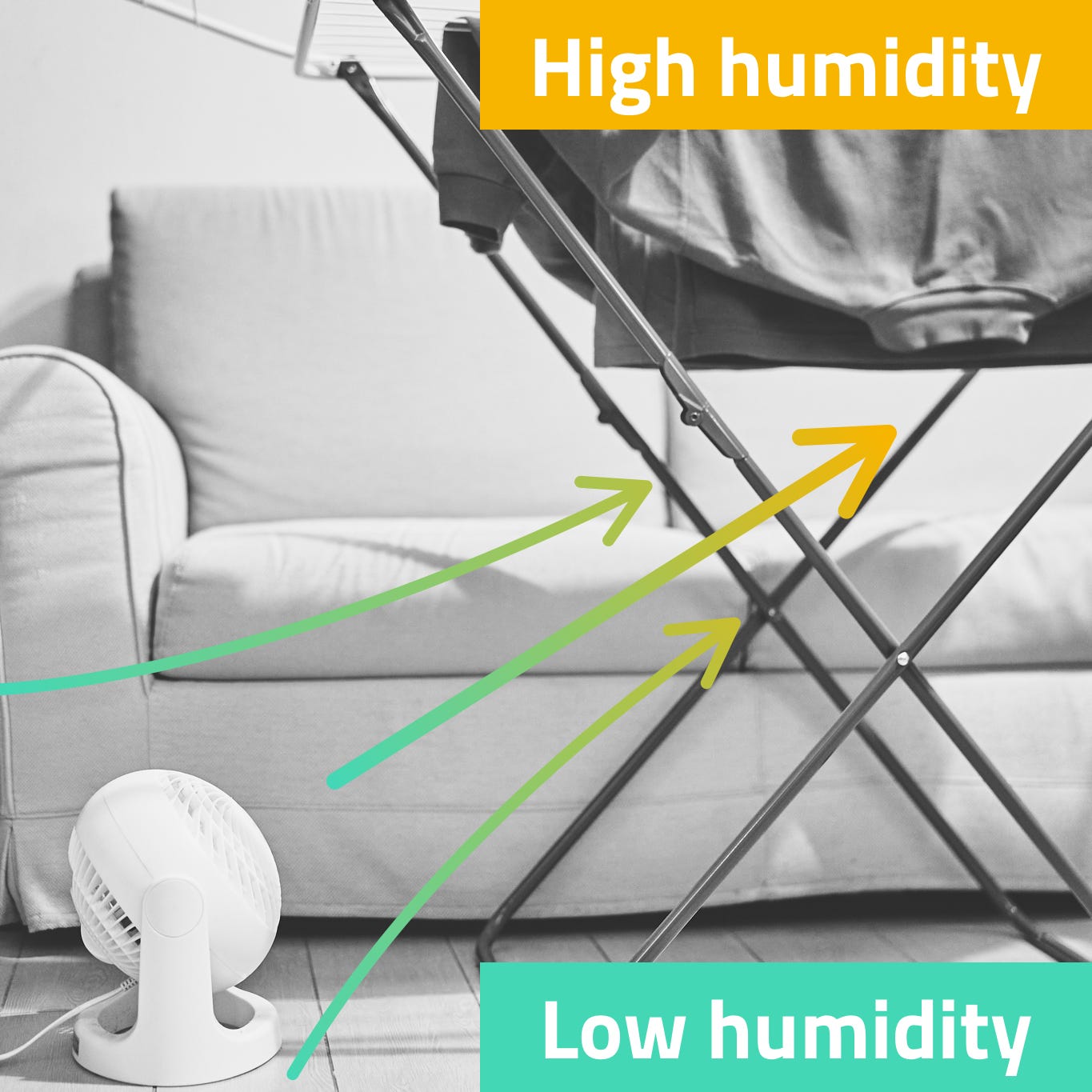
For the most uniform drying process it’s better to put it at some distance from the rack to create a wider flow covering it completely. You can put some water on your hand and place it at different corners of the rack to feel whether the breeze is reaching there. Since you probably won’t take the rack away until the last piece of clothes is dry, it’s better to have a weaker flow covering all of it than a strong flow that only covers a portion of the rack.
💡 Wet skin is much more sensitive to the breeze than dry skin thanks to exactly the same mechanism that I’ve described earlier: faster evaporation takes away more heat from your skin, which makes it feel colder.
Obviously, the clothes will dry faster if you increase the fan speed. It will consume more electricity and add more noise, which might or might not be justified, depending on your circumstances. But having a slightest breeze makes a huge difference compared to just stale air.
A few final touches
There are a few smaller details that might seem excessive, but ultimately they do make a difference as well. Keep in mind though that some people might think you have some kind of mental disorder when you go that deep into the details.
First, you can choose a better folding line than right in the middle when hanging your clothes. The idea here is to balance both sides in terms of weight, without any parts hanging too low, like long sleeves of a sweater or ever shorter sleeves of a T-shirt. This has to do with water being pulled down by gravity, while the evaporation happens mostly at the top. If you let too much water accumulate in a single spot, like at the bottom of the hanging sleeves, you’ll end up with them staying wet long after the rest has dried out. The same applies to trousers, where you have thicker fabric with pockets at the top, which hold more water than the thinner parts at the bottom. Placing that top part higher distributes water more evenly throughout the fabric, letting it evaporate faster.
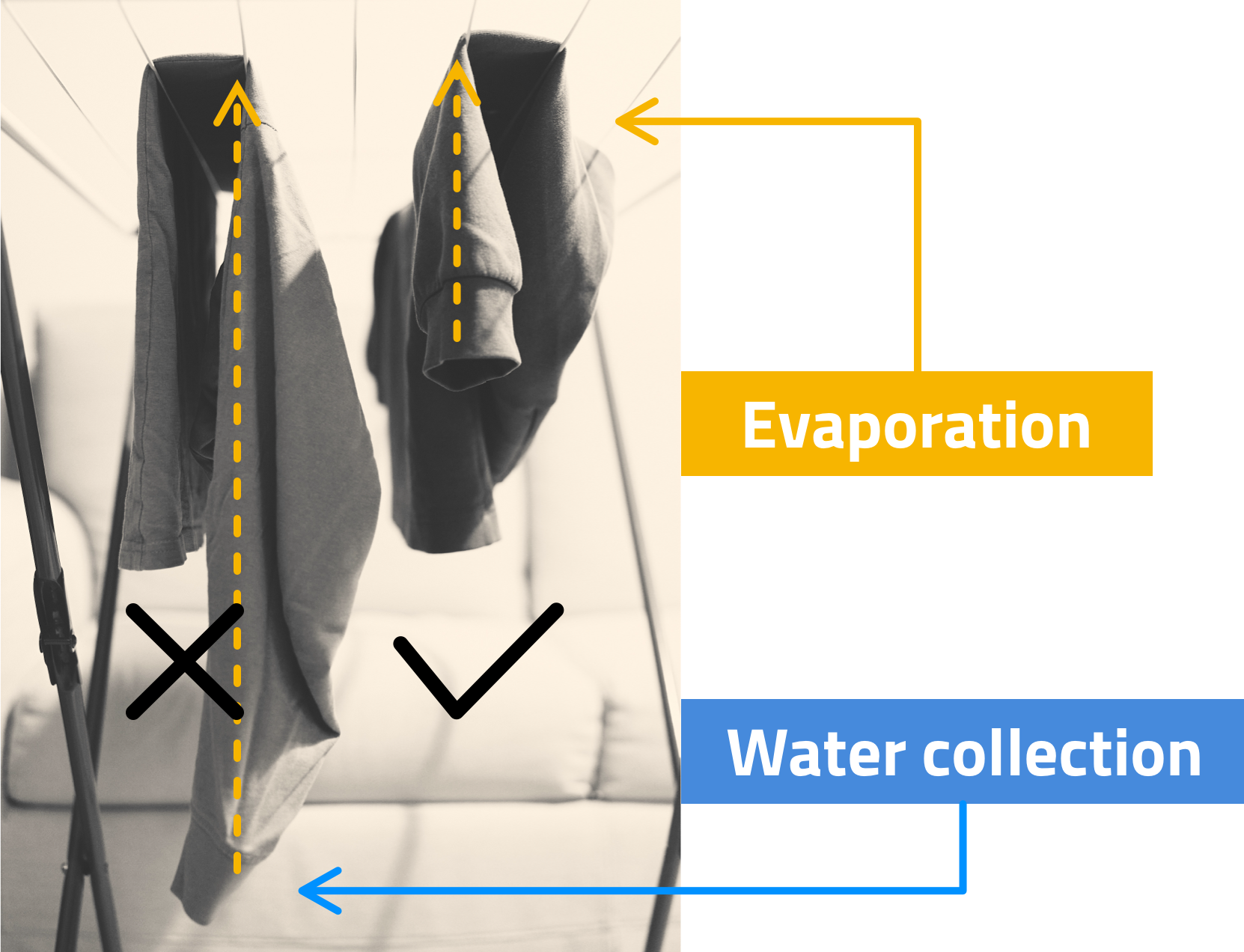
Finally, you can rotate them when one side is almost dry and the other one is still wet. That would be the external side of the fold if you’re not using a fan, or the inner side if the air flow from the fan is strong enough. Either way, if there is such an asymmetry, you can flip your clothes, exposing the wet side of the fabric to the faster-drying environment.
Epilogue
As you can see, there is plenty of physics going on even in such a simple thing as drying your clothes. It involves heat, humidity, air flow, fabric thickness and surface area, etc. It can easily get extremely complex if you want to simulate every aspect of it to the last detail, which would involve the Navier-Stokes equations4 with lots of math. Yet there are plenty of ways to use physics in everyday life just at the level of concepts, basic understanding and logics, which is not as complicated and boring as the school curriculum makes it seem.
I hope that I’ve demonstrated this through a meaningful example and made you appreciate the power of scientific approach in particular. You can simply decompose a complex process into individual components and understand the dynamics of each of them. That is enough to judge what is the best way to get the outcome you want under any circumstances.
More cases like this will follow as I keep writing articles from my to-do list.
Subscribe below to not miss them!
What Is Lüften, and Does It Work?, Timberwise